Friday, November 15th, 2013  I’m an eavesdropper. I admit it. I’m an eavesdropper. I admit it.
Wherever I go, I’m tuning in to the things that are being said around me.
I’m a snob, though. I generally don’t listen in on conversations between, for instance, the barista and the guy in front of me buying coffee. The guy buying coffee is passing time, waiting for his extra foamy tallboy. The barista is paid to be charming.
That conversation? Worthless. Usually.
I might listen in if there’s no one else around, but I’d rather listen to the old folks behind me, talking in hushed whispers. Or the goth couple hanging out in the corner arguing.
I love it when I’ve already sat down and gotten my coffee. (Black thanks, I’ll add a bit of cream for myself.) Because if I’m sitting, I can take notes. Awesome.
Conversation is great fodder for scenes. It can prompt entire stories.
Here’s Your Prompt:
(And your homework!)
Make time to sit in a place where you can overhear what other people are saying. With luck, you’ll start hearing things in the middle of the conversation.
After you’ve written a few lines, stop listening and re-read what you’ve written down. What story does it spark? Write it.
If you don’t like the first conversation, go listen to another. This time, stop transcribing when something catches your fancy.
If you can’t get out, do an internet search for “overheard conversations.” There are tons of them out there. Ignore the context and the celebrity of who said what. Find a conversation you like, and write from there.
Good luck!
Friday, October 4th, 2013  I just got a new treadmill, ostensibly to shed a few pounds gained during my two foot surgeries in the last year. I prefer running outdoors, but with winter coming, the treadmill is the best bet to get back on track during the darker winter months here. I just got a new treadmill, ostensibly to shed a few pounds gained during my two foot surgeries in the last year. I prefer running outdoors, but with winter coming, the treadmill is the best bet to get back on track during the darker winter months here.
A few of my writer friends have turned their treadmills into writing desks, citing all the health benefits of obliterating a sedentary lifestyle. Not wanting to be left out, I’m giving it a try.
The Husband of Awesome™ and I made a trip to one of those lumber superstores and purchased a plank, some eye bolts and bungee cords. In less than an hour, I had a fairly decent makeshift desk on the arms of a treadmill. A ‘breakfast in bed’ lap desk (never used, alas!) and a cardboard riser on top the plank have lifted the keyboard, monitor and mouse to the appropriate level.
It’s fairly comfortable, and I spent an hour on the treadmill Wednesday, after my workout, to read email and work on my WIP (walking uphill at 1.7 miles an hour).
I got a lot of work done!
And it prompted me to do some research on the correlation between exercise and creativity. There’s plenty of research to be found, such as this paper on exercise and creativity by doctors David M. Blanchette, Stephen P. Ramocki, John N. O’del and Michael S. Casey.
They found that, “aerobic exercise may positively impact creative potential, and that these effects may extend for some period of time,” and “results suggest that orthodox aerobic workouts have potential benefits in aiding creativity processes, [and that exercise] potentially provides tangible improvements to creative productivity.”
So, exercise may not only help the creative process in individuals, but it may improve it!
Here’s Your Prompt:
- Go do some aerobic exercise! Take a run, walk briskly, jump rope, etc. for a half an hour. (Standard disclaimer here: please check with your doctor to make certain you’re fit before starting any exercise program!)
- Pull out a creative project that’s been giving you some trouble: a poem where you can’t find the right words, a story you’re blocked on, an art project you just can’t envision, etc. …and give it another try. Or…
- Start a project you’ve been meaning to get to, but has seemed daunting in the past. (Perhaps the exercise will help you think more clearly about how to proceed…) Or…
- Spend some time on your WIP. Do you have a better idea of how to proceed? A more clear idea of where to incorporate plot points or messages or meter? Perhaps you’ve thought of a new idea to add to the work.
Good Luck!
~~~~~~~~~~~~~~~~~~~
Image, “Runner’s Feet,” Copyright: Warren Goldswain. Used by permission.
Friday, September 27th, 2013 Today’s writing prompt is brought to you by the wonderful cephalopod: the octopus. The video below shows how quickly (less than a second in some instances) an octopus can blend into its surroundings.
Most people try to do the same thing, as first evidenced in grade school: wear what everyone else is wearing, get the most popular haircut, carry the same backpack.
What happens if you don’t? Nothing, if you’re lucky. But if you’re the kid (or the adult, even) who stands out, you often face a boatload of ridicule.
(An aside about ridicule: it’s nothing to be scared of.)
And it doesn’t even have to be your accessories which make you different: did you go prematurely gray in high school? I knew a fellow. Need the first “training” bra? Have ultra-curly hair?
You see where I’m going?
Here’s Your Prompt:
- Write about a character who needs to blend in: Maybe he’s a detective who’s following a kidnapper. Or someone with a notorious past who just wants to be left alone. Maybe your character is an alien who’s just trying to pass. Maybe it’s a girl in high school.
- Write the opposite: write about the guy who refuses to conform, fit in, or blend. What kind of abuse does he take? Maybe he’s too touch to be abused. Is he spurned or idolized?
- If you journal, write about a time you stood out, and really would have preferred not to.
Good Luck!
Friday, September 13th, 2013 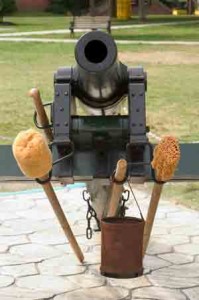 September is National Preparedness Month. Since I work for a government agency, we’re getting repeated reminders to: September is National Preparedness Month. Since I work for a government agency, we’re getting repeated reminders to:
- Stay Informed
- Make a Plan
- Build a Kit
- Get Involved
…all with the usual hype and rhetoric.
(I’m all for being prepared, btw, I just don’t think it should be a crazed, one-month endeavor. Shouldn’t you be prepared all of the time?)
I don’t know if it’s related to Preparedness month, but the local constabulary hijacked our public parking lot Monday morning to hold some kind of drill or training session. Most had on helmets and were holding those clear, riot-control, body shields.
All I could think of on my way out to lunch was, “Time to speed! Floor it!” With all the local police tied up playing war, there couldn’t have been a better time. I wish I could have laid down some rubber on the way out of the parking lot.
Here’s Your Prompt:
Good Luck!
Friday, August 9th, 2013 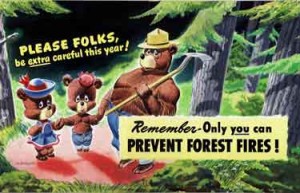 Happy Birthday, Smokey the Bear! Happy Birthday, Smokey the Bear!
I have a fondness for Smokey, and it started long before I started work at the USDA. There’s just something about his forlorn seriousness, captured in so many US Government posters, that tugs a little at my heart strings.
Smokey the Bear gets his name from “Smokey Joe” Martin, the assistant chief of the New York City Fire Department from 1919-1930. He was first painted by Albert Staehle in 1944, then by others, most notably Rudolph Wendelin who painted images of Smokey from 1949 until his retirement in 1973.
The National Agricultural Library in Beltsville, MD has an on-going exhibit of Smokey Posters, and their Special Collections Unit has so much more available for perusal in the stacks (you’ll need to make an appointment). You can read about the Library’s Smokey the Bear Collection here. (Scroll down for some great pictures!)
Smokey’s message remains the same after all these years: Only You Can Prevent Forest Fires – though there were some additional messages along the way, like during war time — “Careless matches aid the AXIS” — mostly faded now into history.
The Library’s Smokey the Bear Collection consists of 115 linear feet of stuff, including 20 map case drawers, 53 boxes, and over 100 films.
I’ve used information in the the container list for today’s prompts. It’s not a long stretch to see how forest fires might have some far-reaching consequences. A little carelessness can go a long way.
Here’s Your Prompt:
The following slogans come from Smokey the Bear posters through the years. Use one or more of the phrases as a leaping off point for a scene, poem or short story.
Feel free to deviate. For example, substitute some other crisis or disaster for fire. Or, substitute another place in lieu of a forest.
- Careless matches aid the AXIS.
- Fire means less schools, roads, tourists, game timber and higher taxes.
- Another enemy to conquer. Forest fires 9 out of 10 times can be prevented.
- A forest’s future is in your hands.
- Please be careful with the future.
- Think.
- Every tree is a family tree. So, please help Smokey.
- Forest Fires catch fish, too.
- In the time it took to grow this tree, we grew a country.
Good Luck!
Friday, August 2nd, 2013 August is National Eye Exam Month.
Coincidentally, I just had my eyes examined. This year, the doctor took photos of my eyes to check for abnormalities. It was a completely painless – and quick – procedure, but anxious-making if only because it’s considered a “medical” test and had to be scheduled outside of the regular eye exam.
And after the exam, which meant the doctor saw something she didn’t like.
What she saw, if unchecked, could result in total blindness for me. (I’m safe, by the way. But it’s still something the doctor wants to watch.)
But the process reminded me of a question someone asked me once: would you rather go blind or go deaf?
I apologize if I’ve offended any of my deaf or blind friends with this question, but I hope you’re agree that it makes for an interesting discussion–if just in the abstract. The point is: what type of major loss–perhaps something you take totally for granted–could you live without the best?
It’s still an awkward question, I know.
My answer: I’d rather go deaf. Tough choice for me, really, but those of you who’ve ever visited or driven in a car with me know: I’ve got music blasting all the time. It’s a major part of my life. Music is pure emotion without any words.
(Song writers, I promise you, are geniuses.)
I think living without music would kill a little part of me. If I couldn’t be a writer, I’d definitely be a musician. But still, I’d rather go silent then dark.
I think I could remember the music better than I could remember sight. Memories fade–images fade–but I’m not certain about tunes. Then again, maybe it’s me.
Try this experiment: picture in your mind the face of a relative long gone. Describe their features, exactly how you remember. Now find a photo and compare. How accurate were you?
Next: try to sing an old nursery rhyme you learned as a child. Can you do it? Maybe Twinkle-Twinkle Little Star or the ABC song… Try one you can’t remember the words to. Can you still hum the tune?
Here’s Your Prompt:
- Write: would you rather be deaf or blind?
- Sit for one minute with your eyes closed in a busy or semi-busi location. After a minute or so, write down the sensations you had, the things you noticed with your other senses: touch, taste, sound, etc. Now try the same experiment with your eyes open. What’s the difference?
- Find someone who won’t mind you invading their personal space. Now, look into his or her eyes. What do you see there? (Do you see something you haven’t seen before?) Is this the first time you’ve been this close? Eyes are supposedly the ‘windows of the soul.’ Write about your friend’s soul.
- Write about a memory “through the eyes of a child.” That is, exactly how you remember feeling as a kid about it. Now try writing the same scene as “through the eyes of a stranger.” How do the perceptions differ?
Good luck!
Friday, June 28th, 2013  Most people work to earn a living. Most people work to earn a living.
So, unless you write about fabulously wealthy people all the time, I’m going to assume that your characters are working-class folk.
And even if you write fantasy, your character is going to have to make a living somehow–whether it be by herding sheep or in the castle guard–so I think you might find this useful.
For most people, work defines who they are. When you meet someone at a party, you’re inevitably asked, “What do you do?” We’re slotted into pigeonholes at first meet: he’s a computer programer, she’s a lawyer, he owns a plumbing and heating company…
This works for fabulously wealthy people who spend their time on good causes, too: She does books for a soup kitchen, he’s a doctor at a free clinic, she reads to the blind.
And like it or not, what we do for a living–or to fill the time–shapes us. We spend a huge amount of our time in pursuit of it: exposed to the politics, embroiled in projects, learning our pecking order, gaining experience both good and bad.
So knowing what your character does for a living is important–even if it’s never mentioned in the book. Because what he learned on the job is a takeaway to his life. Keep this in mind when creating new characters.
Here’s Your Prompt:
- Write a scene or a story about an important event in a person’s life…but come at it from the perspective of work: you can only reveal things as they are happening on the job.
- Write a story about a person who keeps making the right decisions at work, but keeps landing in deeper and deeper trouble for them.
- Write the scene (or an entire story) about a bitter person who’s got the dream of a lifetime–her dream of a lifetime–and how it ruined her.
- Go large on the work idea: write a story that takes place at a business. The characters can only be seen as how they act on the job – no scenes away from the workplace.
- Write a story where your main character is having trouble keeping his job. This difficulty can be central to the story or not.
- If you Journal…
- Write about the loss of your job.
- Write about all the summer jobs you’ve had, or about your favorite summer job.
- Write about your Worst. Job. Ever. (Or worst boss!)
- Have you ever been profoundly effected by someone else’s job — or job loss? Write it.
Good Luck!
Friday, May 24th, 2013  I’m heading over to Balticon later on today, and it’s been a frenetic week preparing. Not because I’ve got such a large schedule — I deliberately don’t have much of one at all this year — but because life just got in the way. I’m heading over to Balticon later on today, and it’s been a frenetic week preparing. Not because I’ve got such a large schedule — I deliberately don’t have much of one at all this year — but because life just got in the way.
I’m sure there’s a blog post/writing prompt for “life getting in the way” but that seemed kind of vague to me this morning. Watch for it later, I’m certain.
So, today’s prompts are rather random. Just some ideas I’ve been playing with that haven’t gone together for one huge post…and they all start with the photo.
Your options: choose the photo for the prompt, one or some of the prompts, or all of them (that might prove interesting!) and write away.
The Random Prompts
- A woman on her honeymoon is shocked to learn a major secret from her husband’s past.
- “Uncle John, I don’t like this.”
- I loved her with all my heart – but every day she became more of a leech.
- While driving to work one day, you decide to drive by the office, and just keep going.
- A woman on her honeymoon is shocked to learn a major secret from her husband’s past.
Friday, May 10th, 2013 I got sued this week for nearly $10,000.
I received two letters in the mail from attorney’s wishing to represent me.
The only problem is, I am not the Kelly Harmon that everyone’s looking for.
I phoned the attorney who represents the plaintiff, and his assistant apologized: they were certain I was the wrong person when they filed the paperwork with the courts, but they wanted to have something in the case files while the other Kelly Harmon is MIA.
(This raises my hackles on all kinds of levels, not withstanding the fact that it appears in public court documents that I skipped town after not paying rent for a few months. But why would an attorney knowingly put false information in court records?)
But we’re getting away from the topic here: mistaken identity.
If I hadn’t proactively called the attorney on the case, I would have been served with papers. (While I was chatting with the assistant, she put me on hold to call the process server and tell him not to drop by my house.)
Being served would have opened up a whole host of problems: all of which are fun to put your characters through…but no fun to live through in real life.
I got lucky. Here’s hoping that your character isn’t!
Here’s Your Prompt
- Imagine you’re approached on the street by a stranger who greets you as though he knows you. Instead of claiming mistaken identity, decide to continue the discussion to see where it leads. Write the dialogue and setting of such a situation.
- Write the story from the opposite point of view: you’re the man who greets the other as if he already knows him. The twist: you know you don’t know him, and you’re trying to scam him in some way. What’s the scam? What happens?
- Write about a character who gets in trouble because of mistaken identity (is sued, or caught by a bounty hunter and thrown in jail, or becomes the target of a smear campaign, or is beaten up by a raging family member hell bent on getting revenge for someone, etc). How does the character clear his name? How is the situation resolved?
Good luck!
Friday, April 26th, 2013  I had lunch with a writer friend yesterday, and as usual, we talked shop. I had lunch with a writer friend yesterday, and as usual, we talked shop.
I finally asked him if he wouldn’t mind looking over a short story I’m writing, because I seem to have written myself into a corner. It’s science fiction, which I love reading, but never seem to get around to writing.
Absolutely he said yes, but then he offered a nugget of advice while plotting: write the last line first.
His method is to write the last line, ask himself how the characters got to that point, then ask how they got to the point preceding that, and so on.
Brilliant!
I’ve never suffered from “writer’s block” because (as I tell anyone who asks) I always “know where I’m going” when I’m writing. How can you be blocked if you know what’s coming next?
Starting from the end is the nth-most point of this. Now, why didn’t I think of that?
(Thanks, Carl!)
Here’s Your Prompt:
- Write a poem, a short story, a scene or vignette by writing the last line first. Think: how will this end? And start from there.
- Think of two story/scene/poem endings, then think of how they each begin. Switch the beginnings of each idea and then write one of these ‘twisted’ stories.
- If you’re having trouble thinking of endings, here are a few ideas you can steal (re-write them once you get to the end!):
- Like thee, may New Switzerland flourish and prosper–good happy and free! – Johann Wyss, Thw Swiss Family Robinson
- “Now, that’s something like! Why, it’s a million times better than pirating. I’ll stick to the widder till I rot, Tom: and if I git to be a reg’lar ripper of a robber, and everybody talking ’bout it, I reckon she’ll be proud she snaked me in out of the wet.” ~ Samuel Clemens, The Adventures of Tom Sawyer
- Then he closed his eyes and humbly surrendered his vanquished throat to the comfort of the blade. Miguel Torga – The Bull, from Farrusco: The Blackbird and Other Stories
- I reckon I got to light out for the territory ahead of the rest, because Aunt Sally she’s going to adopt me and sivilize me, and I can’t stand it. I been there before. ~ Samuel Clemens, The Adventures of Huckleberry Finn
- In this vessel, after a long voyage, I arrived in England, June 11, in the year 1687, having been 35 years absent. ~ Daniel Defoe, Robinson Crusoe
Good luck!
~~~~~~~~~~~~~~~~~~~~
Photo by | Dreamstime Photos
|
Writers - Maryland Writer's Assn.
|

 |
|